
Last updated September 20, 2026
Full 25-point door and opener safety check with every visit - springs, cables, rollers, tracks, and your LiftMaster or Chamberlain opener included
You get a price before we start. It does not change when the truck arrives.
 Before
 After
After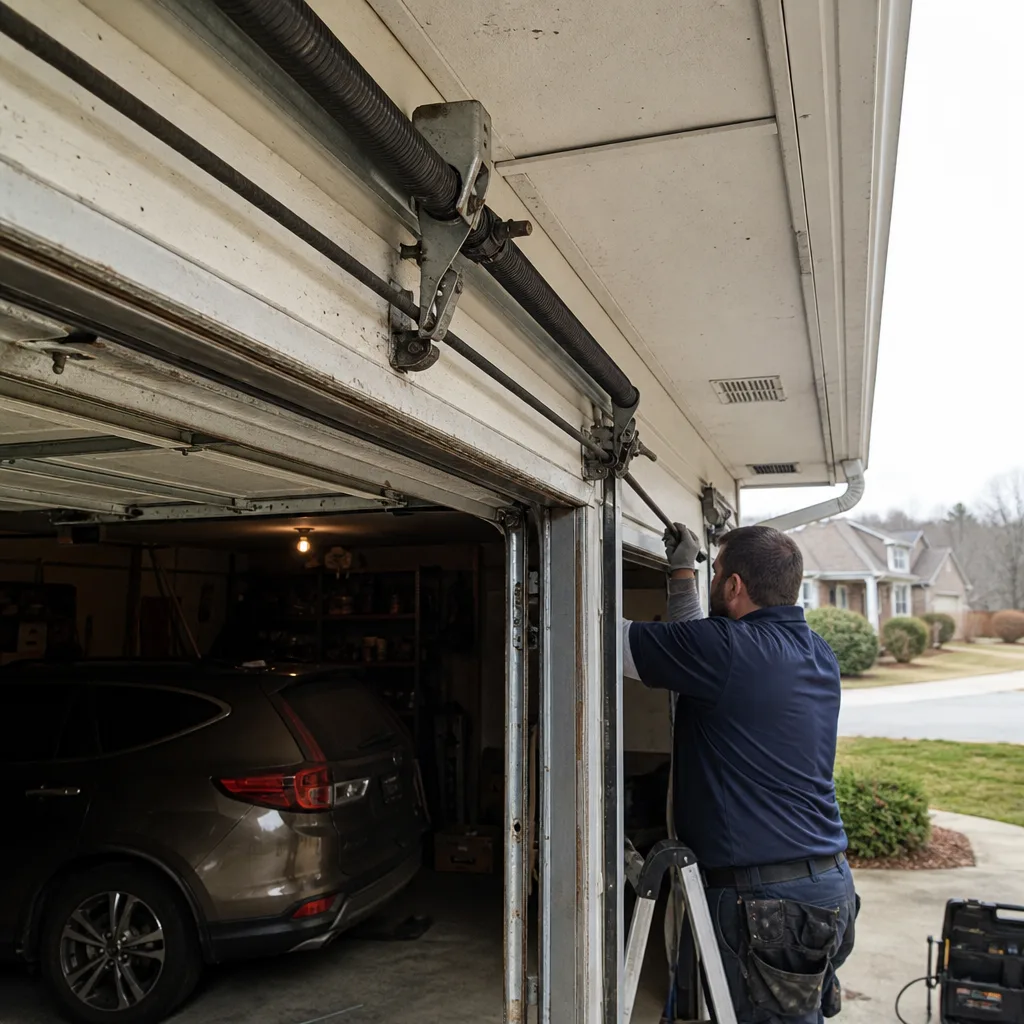 Before
 After
After Before
 After
AfterGarage Door Warning Signs: A Douglasville Homeowner’s Reference Guide
Most Douglasville homeowners treat a misbehaving garage door the way they treat a dripping faucet: something to keep an eye on until it becomes impossible to ignore. That instinct is wrong, but not for the reason you might think. The problem isn’t that a garage door might strand your car in the driveway. It’s that most “warning signs” are actually the door’s safety systems doing exactly what they were designed to do, and by the time the behavior changes, the underlying component has already failed. This guide-along with The Complete Guide to Garage Door in Douglasville-separates cosmetic quirks from mechanical degradation from active safety hazards, so you know what to ignore, what to schedule, and what means stop using the door today.
Quick Answer
A garage door that reverses before closing, makes a sharp popping sound, or has visible cable slack is telling you the entrapment protection or counterbalance system has already crossed a safety threshold, not a convenience one. If your door shows any sign in the “Stop Using Now” tier below, leave it closed or open, don’t operate it manually or with the opener, and call a Douglasville garage door professional, not a handyman. Most mechanical warning signs cost $180 to $340 to repair when caught early in Douglasville, and the written price should be in your hand before anyone touches a bolt.
Table of Contents
- The Three-Tier Classification: How to Judge Any Warning Sign
- Tier One: Stop Using Now (Active Safety Hazards)
- Tier Two: Schedule Within Two Weeks (Mechanical Degradation)
- Tier Three: Monitor at Next Maintenance (Cosmetic or Slow-Developing)
- How to Check a Torsion Spring Without Touching It
- Panel Gaps at the Floor vs. at the Top: Two Different Diagnoses
- The Sound Taxonomy: Grinding, Popping, and Squealing, Mapped to Components
- Works Fine Manually, Struggles on the Opener: The Thirty-Second Test
- Common Mistakes to Avoid
- When to Call a Professional
- Frequently Asked Questions
- The Bottom Line
BeforeAfterThe Three-Tier Classification: How to Judge Any Warning Sign
We use a three-tier system on every service call in Douglasville, and it’s the same framework we’re giving you here. It separates what needs immediate action from what can wait, and it removes the guesswork from the urgency question. The tiers are: Stop Using Now (active safety hazard, door should not be operated), Schedule Within Two Weeks (mechanical degradation that gets more expensive the longer it runs), and Monitor at Next Maintenance (cosmetic or slow-developing issues with no immediate safety or cost consequence). The distinction matters because a homeowner who misjudges a Tier One sign as Tier Three can end up with a door falling off its tracks, and a homeowner who misjudges Tier Three as Tier One can end up paying for work that wasn’t urgent.
Here’s the framework in full, so you can apply it to any symptom this guide covers:
- Stop Using Now: Broken torsion spring, cable off the drum, bottom section separation, door reversing with no obstruction visible, door closing at full speed. The door has lost part of its counterbalance or safety system. Do not operate it manually or with the opener. Call today.
- Schedule Within Two Weeks: Roller wear, slow travel speed, motor hesitation, grinding during travel, loose hardware. These are mechanical wear that compounds. Every cycle adds wear to adjacent parts. Two weeks of normal use won’t create a safety hazard, but six months will turn a $220 roller replacement into a $600 track and panel job.
- Monitor at Next Maintenance: Minor seal gaps, surface rust on hardware, slight auto-reverse response lag, mild squealing. Document them with a photo and check again in a month. If the condition is visibly worse, reclassify upward.
In Douglasville, our humidity and temperature swings mean weatherstripping shrinks in winter and expands in August, surface rust accumulates faster than in drier markets, and spring steel develops fatigue differently than it does in coastal climates. We factor that into how we classify wear here, and you should too. A hairline crack in a torsion spring that’s been through ten Douglasville summers is a Tier One sign. The same crack in a spring installed six months ago is a warranty issue, not a hazard prediction, but you still shouldn’t ignore it.
Tier One: Stop Using Now (Active Safety Hazards)
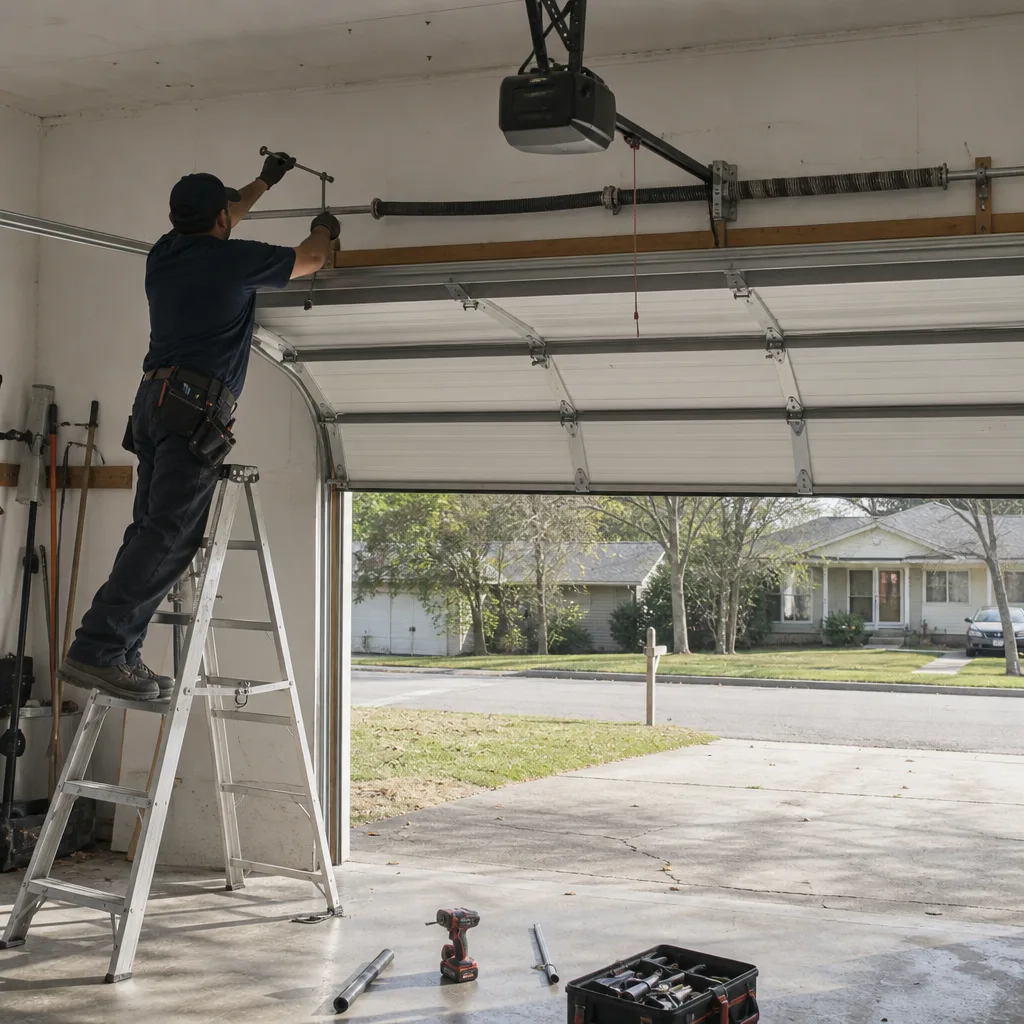
These are the signs that mean the door has lost a component that keeps it from falling, keeps it from crushing something, or keeps it attached to the frame. If you see any of these in Douglasville, stop using the door immediately. Don’t try to lift it manually. Don’t run the opener to “see if it happens again.” Don’t park in the garage until it’s fixed. Here’s what each one means and what to look for.
Broken Torsion Spring
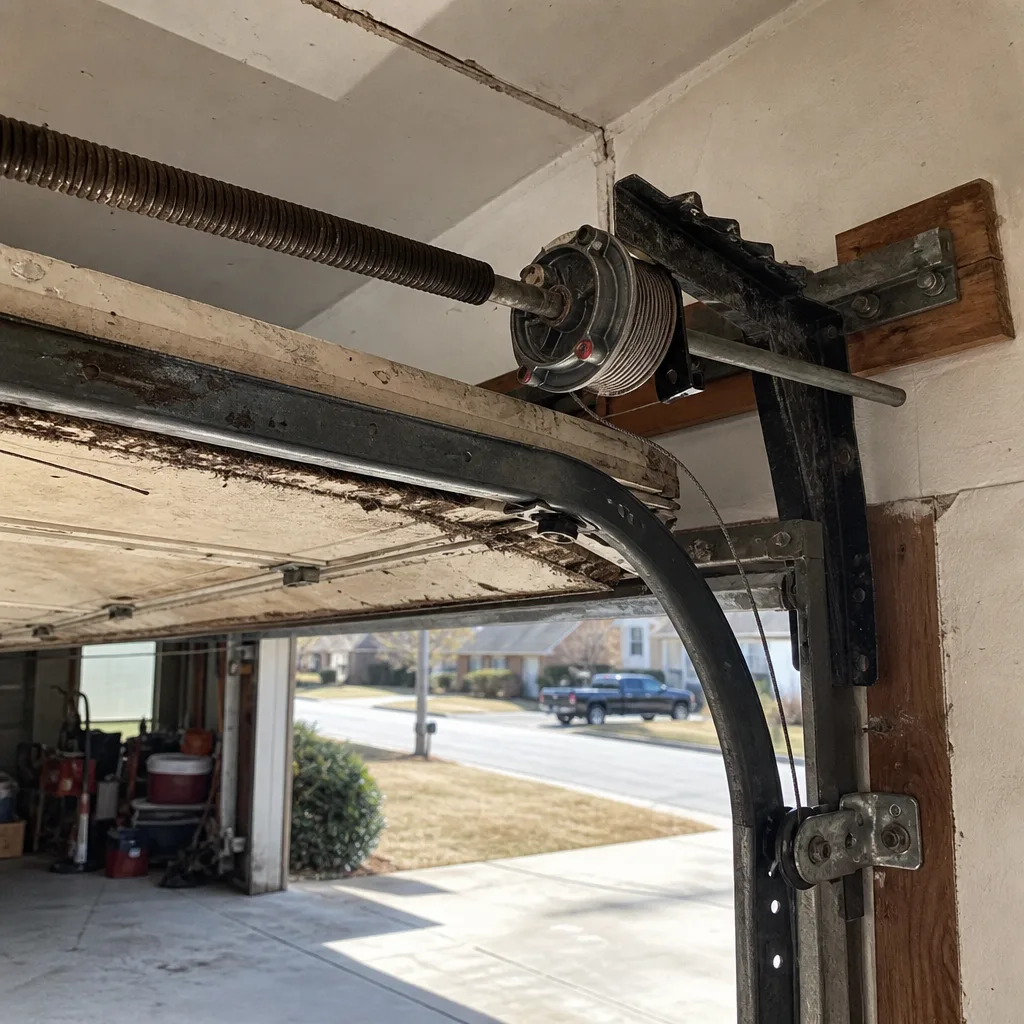
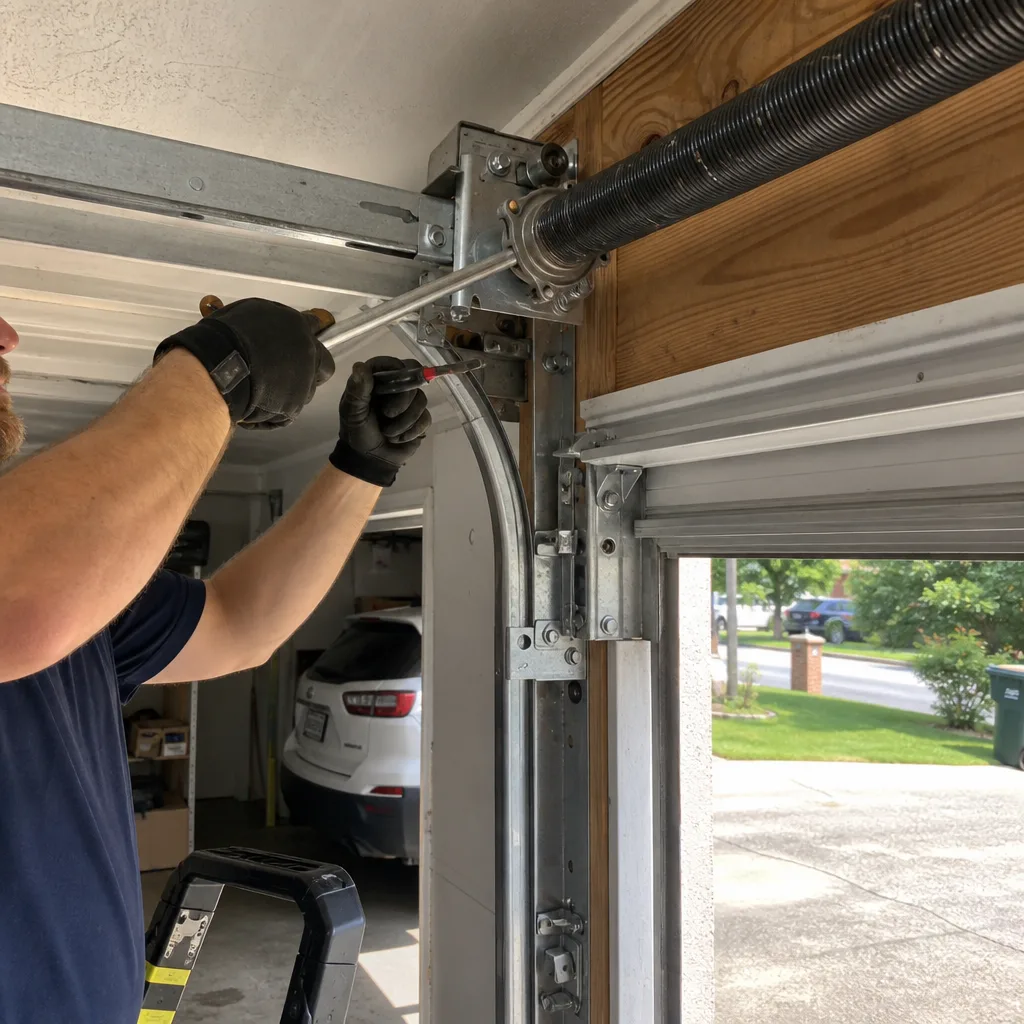
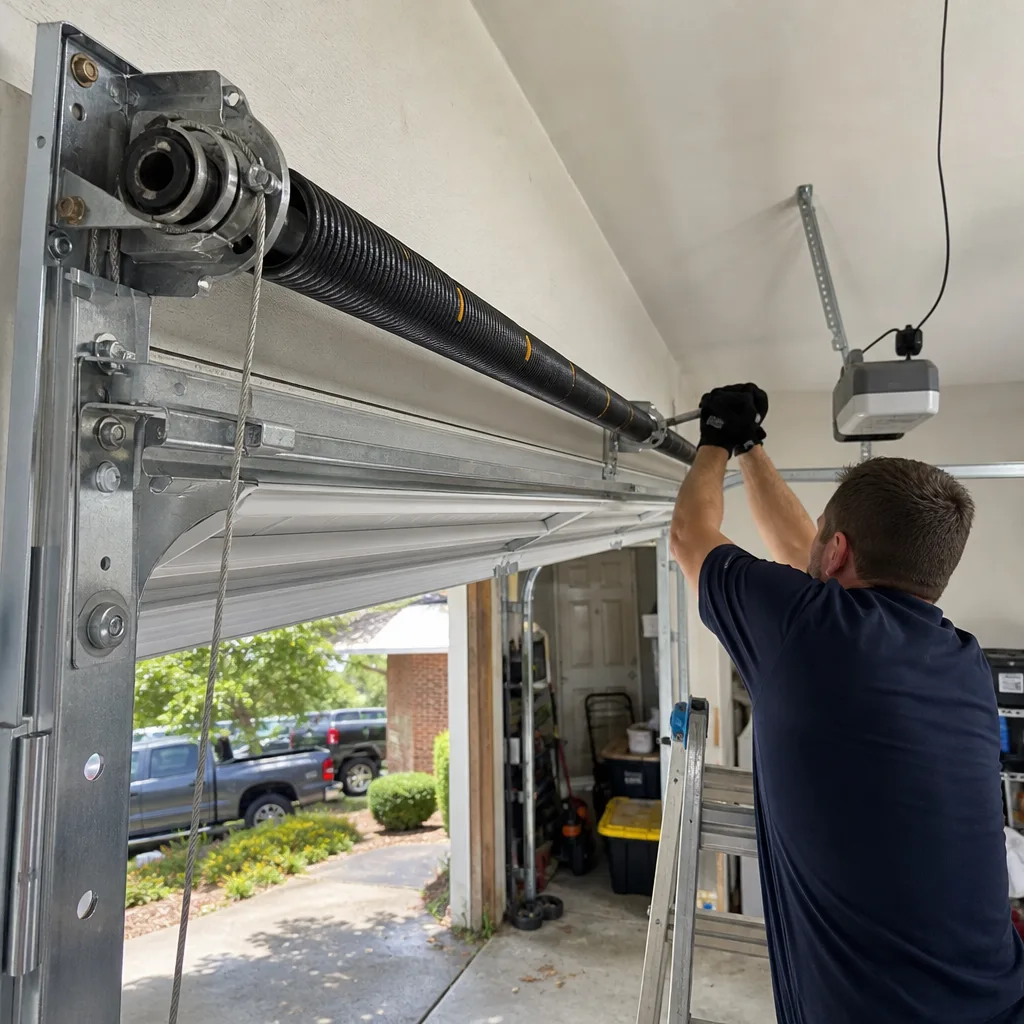
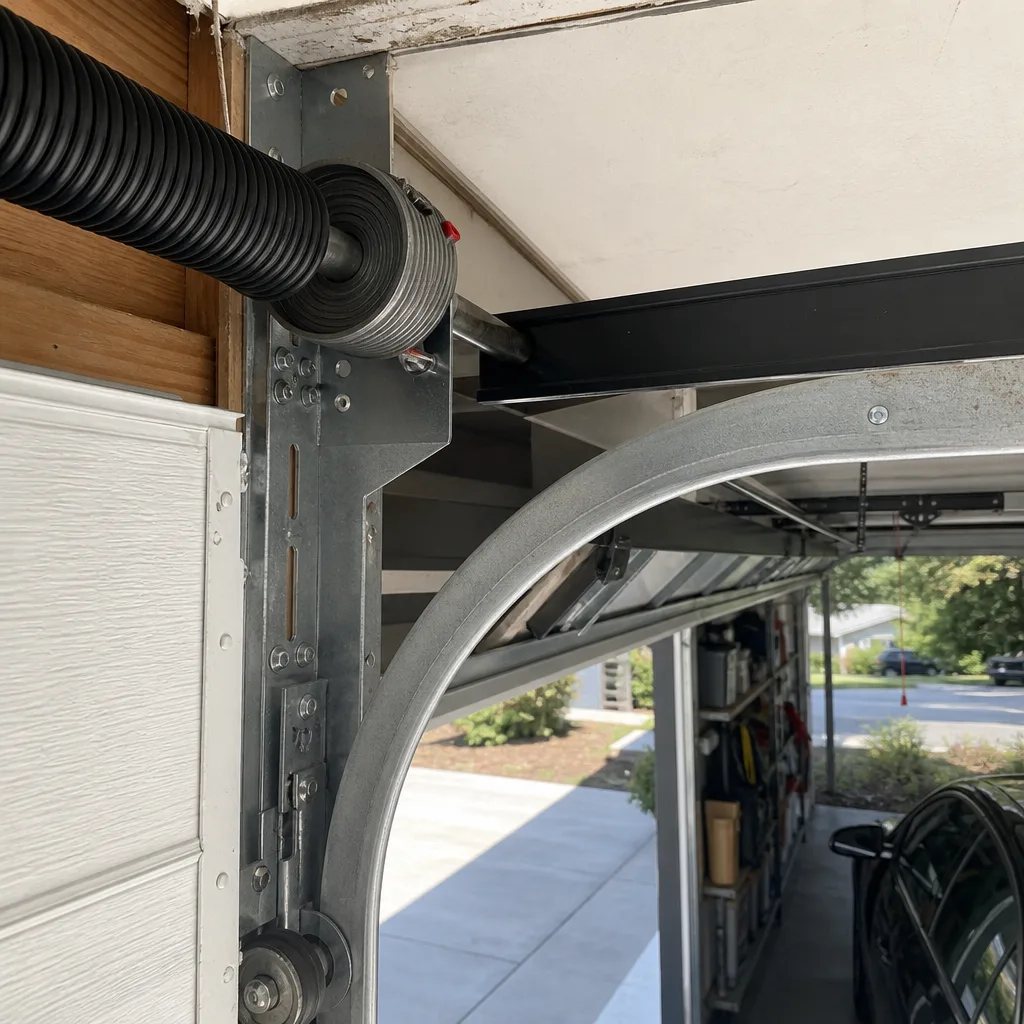
A torsion spring is the coiled steel component mounted above the door opening, on a shaft. It stores the energy that counterbalances the door’s weight. When it breaks, the door weighs its full 130 to 180 pounds, and the opener motor is not designed to lift that. The classic sign is a loud bang from the garage, like someone dropped a 20-pound weight on concrete. After that, the opener will struggle to lift the door or won’t lift it at all. If you look up at the spring and see a visible gap in the coil, it’s broken. Section below covers the visual check in detail.
Cable Off the Drum
The lift cables run up both sides of the door and wrap around grooved spools, called drums, at the top of the shaft. If a cable comes off its drum, it’s usually because the spring broke and released tension, or because the door hit something while closing. You’ll see a loose cable hanging or looped away from the drum, often kinked. A door with one cable off its drum is lifting unevenly, which means one side is bearing the full weight and the other side is dragging. It can bind in the track or pull a panel apart. Leave the door where it is and call.
Bottom Section Separation
The bottom panel of the door is where the lift cables attach. If you see the bottom panel separating from the section above it, or the bottom corner pulling away from the track, that’s the attachment point for the entire lifting system. This usually follows a cable issue or a hard impact, and it means the door can come off the tracks entirely. The floor line of the door will look broken or staggered, and the bottom panel will feel loose if you’re careful enough to check it without operating the door. Don’t.
Door Reverses with No Obstruction Visible
A door that reverses before it reaches the floor is doing what the entrapment protection system tells it to do: it detected resistance and backed off. That means something is creating enough resistance to trigger the sensor, even if you can’t see it. It could be a broken spring (the door is now too heavy for the opener to close gently), a bent track, an object wedged in the track, or a failing logic board on the opener. The point isn’t the cause. The point is that the safety system intervened, which means the door should not be operated until the cause is identified. This is Tier One because the door has already crossed a threshold where the opener is making safety decisions on its own.
We carry Garage Door Repair in Douglasville parts for all Tier One failures on our trucks, including torsion springs in multiple wire diameters and cable sets for all eight major brands we service. If you’re in Douglasville and see any of these signs, the right move is to leave the door alone and call.
Tier Two: Schedule Within Two Weeks (Mechanical Degradation)
These signs don’t mean the door is unsafe today, but they mean components are wearing and the repair cost goes up the longer you wait. Scheduling within two weeks is the correct urgency for Douglasville, where spring and fall are the busiest seasons and getting on a technician’s calendar early means you’re not waiting behind a hundred emergency calls when the weather turns. For a full maintenance schedule, see our Seasonal Garage Door Care for Douglasville: Year-Round Homeowner’s Guide.
Roller Wear: The Grinding Rumble
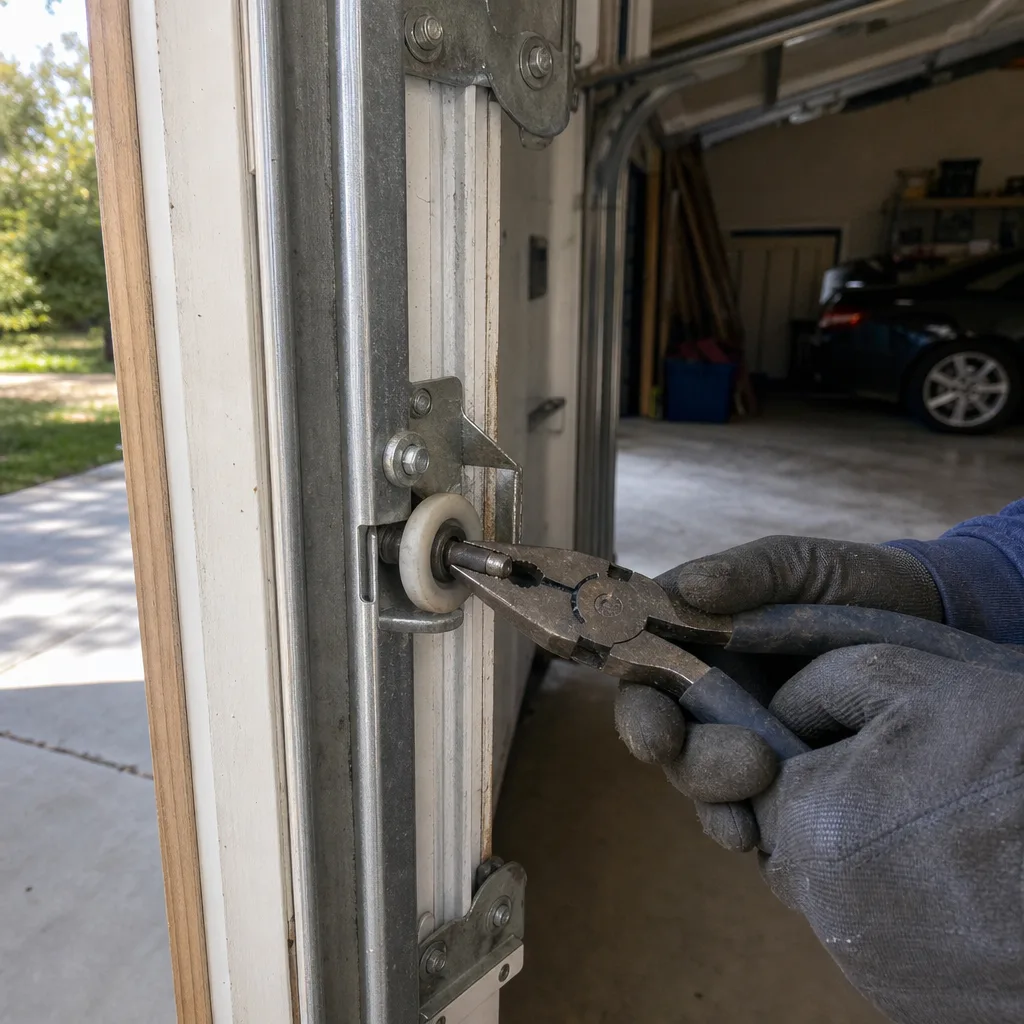
Garage door rollers are small wheels, usually steel or nylon, that ride inside the vertical tracks and allow the door to move. When they wear flat or the bearings inside seize, you’ll hear a grinding or rumbling sound during travel, and the door will feel like it’s hesitating in certain sections of the track. A worn roller can also cause the door to lean slightly to one side as it moves. Rollers last three to seven years in Douglasville depending on door weight and use frequency. A set of 10 to 12 rollers replaced by a technician typically costs $140 to $190 in this market, parts and labor. Wait too long and a seized roller drags on the track, which scores the metal, which requires track replacement at $350 to $500.
Slow Travel Speed
An opener that moves the door noticeably slower than it used to is working against extra resistance. The three usual causes are increasing spring fatigue, worn rollers, or a motor that’s losing torque. If the door is ten years old or more and still on its original spring, slow travel is often the spring losing tension gradually. A spring that’s lost tension will make the door feel heavier at the midpoint, where it’s hardest to lift. This is Tier Two because the door still opens and closes, but the extra strain is being absorbed by the opener motor, the cables, and the hinges. Run it too long and the motor overheats, the circuit board fails, or the spring finally breaks and you’re in Tier One territory.
Motor Hesitation
A door that pauses for a second or two after you press the wall button before the motor engages is usually a capacitor issue, a worn motor bearing, or a failing logic board. The capacitor gives the motor the initial jolt to start spinning, and when it fails, the motor starts slower and slower. This is a Tier Two issue because the door still works, but the component is already degraded. A capacitor replacement on a LiftMaster or Genie opener in Douglasville runs $80 to $120. A logic board replacement runs $180 to $260. Let the capacitor fail completely and the motor won’t start at all.
Loose Hardware: The Rattle at Rest
If you can hear the door rattle when it’s closed and the wind blows, or you see bolts backing out of the hinges, that’s hardware loosening from vibration. Every cycle on the door is a vibration cycle, and over thousands of cycles the nuts and bolts walk themselves loose. Tighten them, or have them tightened, before the hinge pulls away from the panel. A hinge that rips out of a panel is a $400 repair, not a $40 one.
Tier Three: Monitor at Next Maintenance (Cosmetic or Slow-Developing)
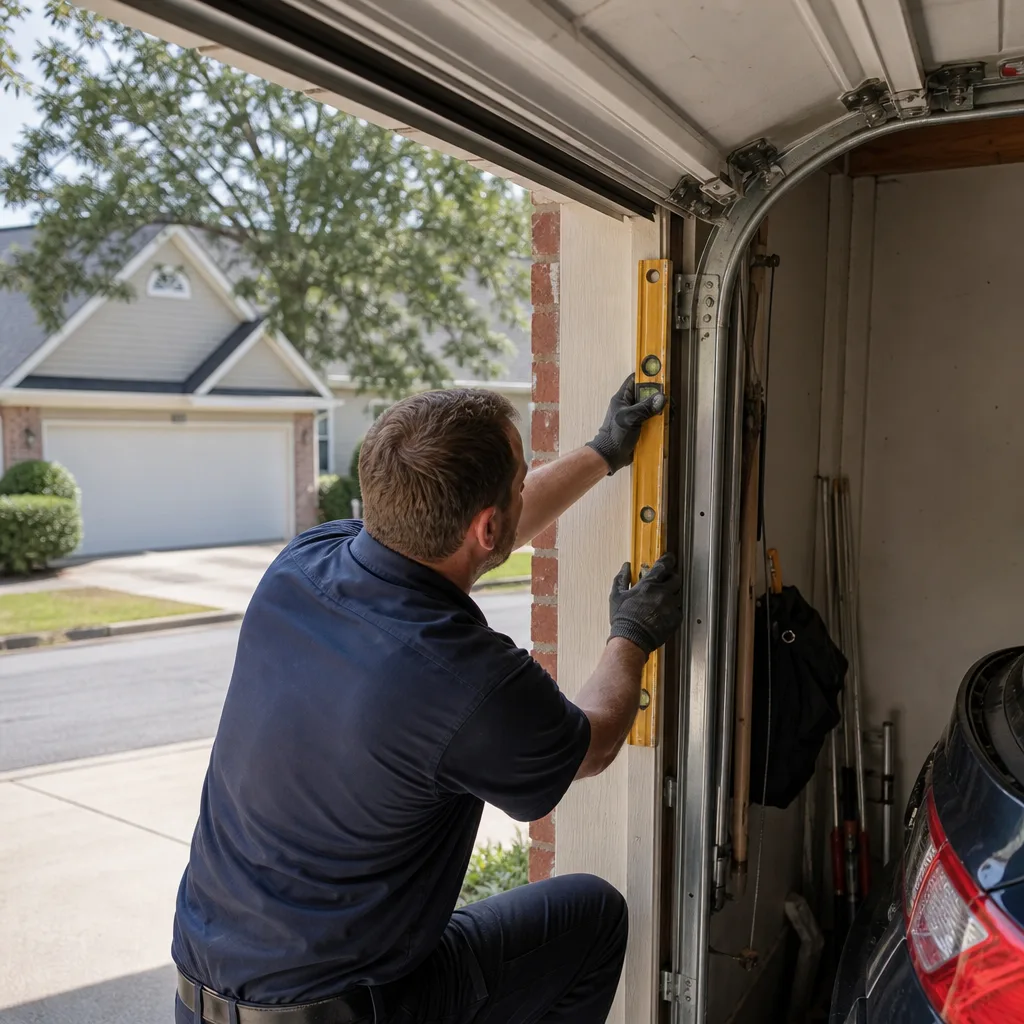
These signs are worth writing down and checking monthly, but they don’t require immediate scheduling. They’re slow-developing, cosmetic, or so mild that reclassifying them upward requires observing a change over time. If any of these get worse in a month, move them to Tier Two.
Minor Seal Gaps
A small gap under the bottom seal, especially visible at the corners, is almost always weatherstripping compression. The vinyl or rubber bottom seal flattens over time, more quickly in Douglasville’s summer heat, and the corners are the first places to show daylight. A bottom seal replacement is a $90 to $130 job and can wait until the next maintenance visit. Monitor it because a gap that gets bigger quickly usually means the door is out of level, not that the seal is compressed. That reclassifies to Tier Two.
Surface Rust on Hardware
Douglasville’s humidity means surface rust on hinges, brackets, and tracks is common, especially on doors that face south or west and get afternoon sun after morning condensation. Surface rust is cosmetic. It doesn’t affect function, and it can be removed with a wire brush and sealed with a rust converter. Deep flaking rust, or rust that has eaten through the metal, is a different matter. That’s structural and belongs in Tier Two.
Slow Auto-Reverse Response
The auto-reverse system on a garage door opener should reverse the door within two seconds of it touching an object. If you test it (place a 2×4 flat under the door’s path and close the door on it) and the door takes a long moment before it reverses, that’s a sensitivity setting or a failing safety sensor. A correct response is immediate. A sluggish response is worth monitoring if the door is still reversing reliably within two seconds, but any delay beyond that is a safety system degradation and should move to Tier Two. In our experience in Douglasville, most slow auto-reverse responses on openers more than eight years old are the opener’s logic board losing sensitivity calibration, not a sensor problem.
Mild Squealing
A high-pitched squeal during travel is usually dry rollers or a dry bearing on the torsion tube. It’s not structural. It’s friction. A few drops of oil on the roller bearings and the torsion tube bearing plates will often quiet it. If the squeal persists after lubrication, or if it’s accompanied by a grinding sound, the bearing is wearing and you’re in Tier Two.
How to Check a Torsion Spring Without Touching It
This is the single most useful visual check a Douglasville homeowner can learn, because it tells you whether a spring is intact, broken, or under tension without putting your hands anywhere near it. We teach this on every service call where a customer asks “how do I know if my spring is broken?” The answer has three parts:
- Look at the winding cone. The winding cone is the metal collar at each end of the spring, where the spring attaches to the center shaft. It has two set screws and a series of gaps, or notches, that the technician uses to wind the spring. On a healthy, intact spring, the coil is continuous and runs right up to the winding cone with no gap.
- Look for a visible gap in the coil. On a broken torsion spring, you’ll see a clear separation in the coil, usually near the center or near one end. The spring will have unwound partially, and the gap will be wide enough to see from the ground. That’s a clean break. The spring is done.
- Look at the winding cone position. If the spring is intact but the winding cone has rotated slightly, or if the spring looks like it has “slipped” a fraction of a turn, the spring is still under tension but the tension is no longer what it was calibrated to. That’s a fatigued spring, not a broken one, but it’s still a Tier Two or Tier One issue depending on how much tension has been lost.
What you’re not doing is touching the spring, the shaft, the cables, or the mounting brackets. The spring is under 200 to 300 pounds of rotational force even when the door is closed, and a slip at the winding cone can break fingers or wrists. We mention this because in Douglasville we’ve seen homeowners attempt to “just tap it” with a hammer to see if it’s loose, and that’s how injuries happen. The visual check above is the entire check. If the gap is there, stop using the door and call.
Panel Gaps at the Floor vs. at the Top: Two Different Diagnoses
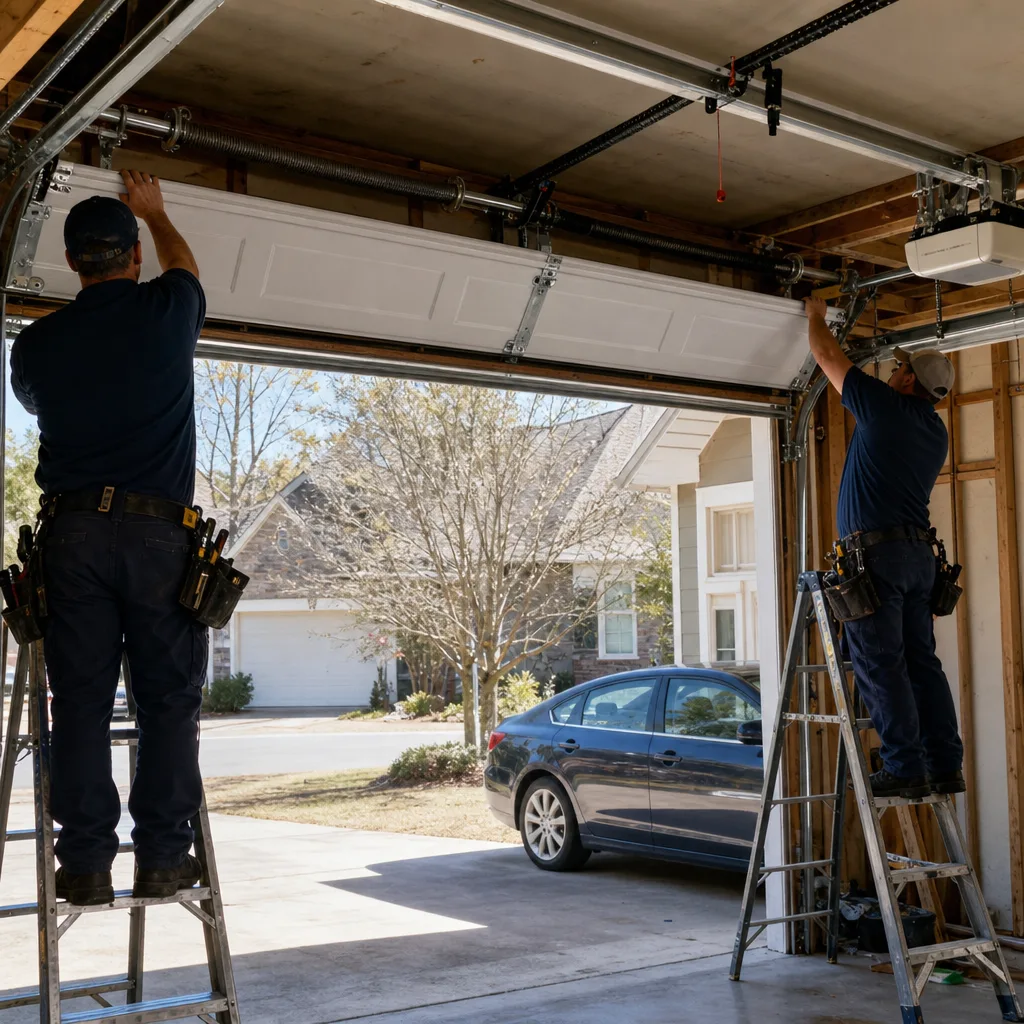
A visible gap between panels is a common warning sign, but the location tells you different things. In Douglasville, we see both patterns regularly, and they are not interchangeable diagnoses.
Gap at the Floor Line (Bottom Panel Pulling Away)
If you stand inside the garage and look at the bottom panel, and there’s a visible gap between the bottom panel and the section above it, or between the bottom panel and the floor on one side, that’s a structural warning. The bottom panel is where the lift cables attach, and it carries the full weight of the door when the door is open. A bottom panel gap means the panel has been pulled, usually by a cable under uneven tension, or by the door striking something hard while closing. This is Tier One or high Tier Two. The concern is cable failure and door collapse.
Gap at the Top Section (Misalignment at the Header)
A gap at the top section, between the top panel and the header or between the top panel and the section below it, usually means the door is out of level or a hinge is wearing. The top section doesn’t bear the same weight as the bottom, so the gap is typically mechanical rather than structural. It can also mean the opener’s J-arm is pulling unevenly, which happens when the opener is mounted slightly off-center or the door has shifted in its tracks. This is Tier Two. It’s not an immediate safety hazard, but it will worsen because the door will keep rubbing against the track and the hinges will keep wearing.
The reason we distinguish these two is that the visible sign looks similar to a homeowner. A gap is a gap. But the diagnosis and the repair are different: a bottom panel gap is a cable and panel integrity issue, while a top section gap is usually leveling and hinge work. Knowing which one you have tells you how urgent the call should be.
The Sound Taxonomy: Grinding, Popping, and Squealing, Mapped to Components
We answer a lot of Douglasville calls that start with “my garage door is making a weird noise.” The first question we ask is what kind of noise. The character of the sound tells us which component family is involved, and it tells you whether you’re looking at a $40 lubrication job or a $300 spring replacement. Here’s the mapping.
Grinding (Low-Pitched, Continuous, Rubs)
Grinding is metal on metal, usually in the track or at the roller bearings. The sound is continuous while the door moves and changes pitch as the door passes certain points in the travel. Likely sources: worn rollers with seized bearings, a bent track, or a roller that’s come off the track and is being dragged. Grinding is Tier Two. If it grinds and the door also shakes, get it scheduled sooner.
Popping (Single, Sharp, Loud, Then Silence)
A sharp pop or bang, the sound that makes you think something broke, is almost always the torsion spring snapping. The sound comes from the spring releasing its stored energy at once. After the pop, the door will be heavy, the opener will struggle or won’t move it, and you’ll see the gap in the coil if you look up. This is Tier One. Stop using the door immediately. In Douglasville, we replace broken torsion springs same-day, and the flat price is agreed before we lift a finger.
Squealing (High-Pitched, Variable, Annoying)
Squealing is friction at the bearing points. It’s dry roller bearings, a dry torsion tube bearing, or dry hinges. The sound is high-pitched and often changes with the speed of the door. Squealing alone is Tier Three, but squealing combined with grinding means the dry bearing has worn and is now scoring the shaft or track, which is Tier Two. Lubricate with a silicone spray or lithium grease on the roller bearings and hinge pins, not on the track itself. If it doesn’t quiet down within a few cycles, call.
The Rare but Real: Rattling (Fast, Metallic, Stops When Door Stops)
Rattling is loose hardware, usually hinge bolts or track brackets. It happens when the door is moving and stops when it stops. Tighten the bolts on the hinges and brackets, or have a technician do it. It’s rarely more than a fifteen-minute fix, but left alone it lets the hinge work against the panel, which eventually tears the screw holes out.
While we’re on sounds: if you hear any sound from the opener motor that isn’t the normal hum, like a high-pitched whine or a clicking that repeats, that’s the motor or the circuit board, not the door. We cover that in the Garage Door Opener Repair & Installation in Douglasville work we handle, and it’s a separate diagnostic from the door itself.
Works Fine Manually, Struggles on the Opener: The Thirty-Second Test
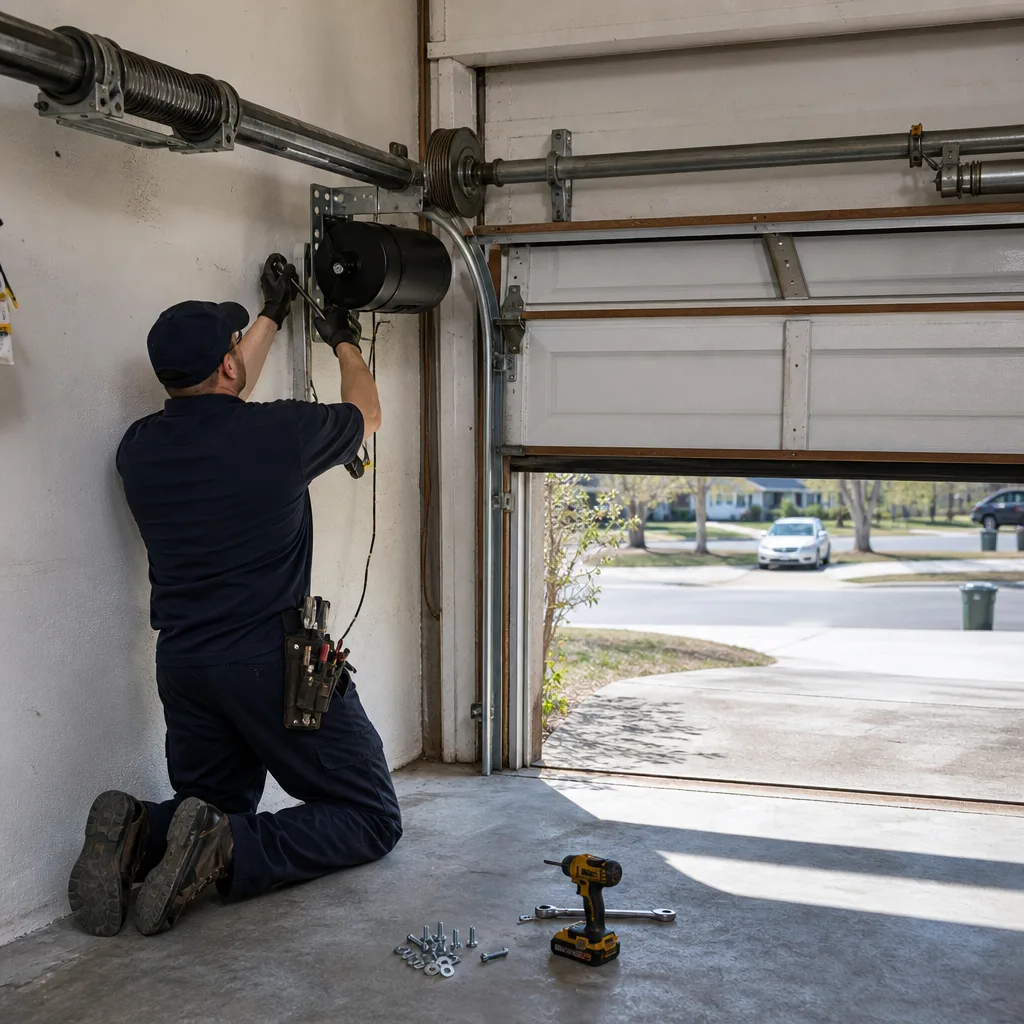
Here’s a scenario we hear constantly from Douglasville homeowners: the door opens and closes smoothly when they pull the emergency release and lift it by hand, but the opener struggles, moves it slowly, or reverses partway. The homeowner concludes the opener is the problem. We find that conclusion is right about 40% of the time. The other 60% is mechanical friction that the opener is fighting, and a hand-lift won’t reveal it because a person’s arm can’t feel the same incremental resistance a motor does.
The thirty-second test that separates the two:
- Pull the emergency release cord so the door is disconnected from the opener.
- Lift the door manually to the halfway point (about waist height) and let go.
- Watch what happens. A properly balanced door will stay at the halfway point, or drift very slightly. If the door drops more than six inches, the spring has lost tension and the opener is fighting that extra weight. If the door rises, the spring is over-tensioned. If the door stays put but the opener still struggles, the problem is the opener motor, the capacitor, or the circuit board.
This test works because it isolates the counterbalance system. The spring should hold the door’s weight at the midpoint. If it doesn’t, the spring is the problem, not the motor. We do this test on every diagnostic call where the complaint is “the opener struggles.” It takes half a minute and it tells us whether we’re replacing a spring or repairing an opener. For a Douglasville homeowner, it tells you which kind of technician to call, and it keeps you from paying for an opener repair on a door that actually needs a spring.
One note: if the door drops quickly when you let go, don’t try to stop it. Let it go and step back. A door that drops fast has no counterbalance, and trying to catch it is how shoulders get injured. Just let it reach the floor and then call.
Common Mistakes to Avoid
- Lubricating a door that’s already grinding. Lubrication helps dry bearings. It does not help worn or seized bearings. By the time a door grinds, the roller bearing has been damaged, and oiling it just makes the metal paste slippery. Replace the rollers, then lubricate.
- Adjusting the spring tension based on a YouTube video. Torsion springs carry enough force to cause serious injury or death when mishandled. In Douglasville, we see the aftermath of DIY spring work every year. Watch the video as education, but let a technician do the winding.
- Ignoring a reversing door because “it still works.” A door that reverses before closing is a safety system firing. Repeated cycles with a reversing door put strain on the opener, the spring, and the cables, and the underlying problem gets worse. This is the most common warning sign Douglasville homeowners put off, and it’s the one that most often turns a $150 repair into a $500 one.
- Replacing the opener when the door is the problem. If the door is heavy because the spring is fatigued, a new opener will struggle just as much as the old one within six months. Test the door balance before you test the opener. The thirty-second test above does exactly this.
- Using the garage door as a daily entry door without checking it. Many Douglasville families enter and exit through the garage more than the front door. That means the door cycles 1,500 to 2,000 times a year, and every warning sign develops faster than it would on a door used twice a week. Give it a thirty-second visual check once a month: cables, rollers, hinge bolts, spring gap.
- Assuming a new home means a healthy door. Douglasville grew fast between 2015 and 2025, and many new-construction doors were installed with builder-grade springs and rollers that wear out in five to seven years. If your door is original to a 2018 or 2019 build and it’s making noise, the components are likely at the end of their build-cycle lifespan.
When to Call a Professional
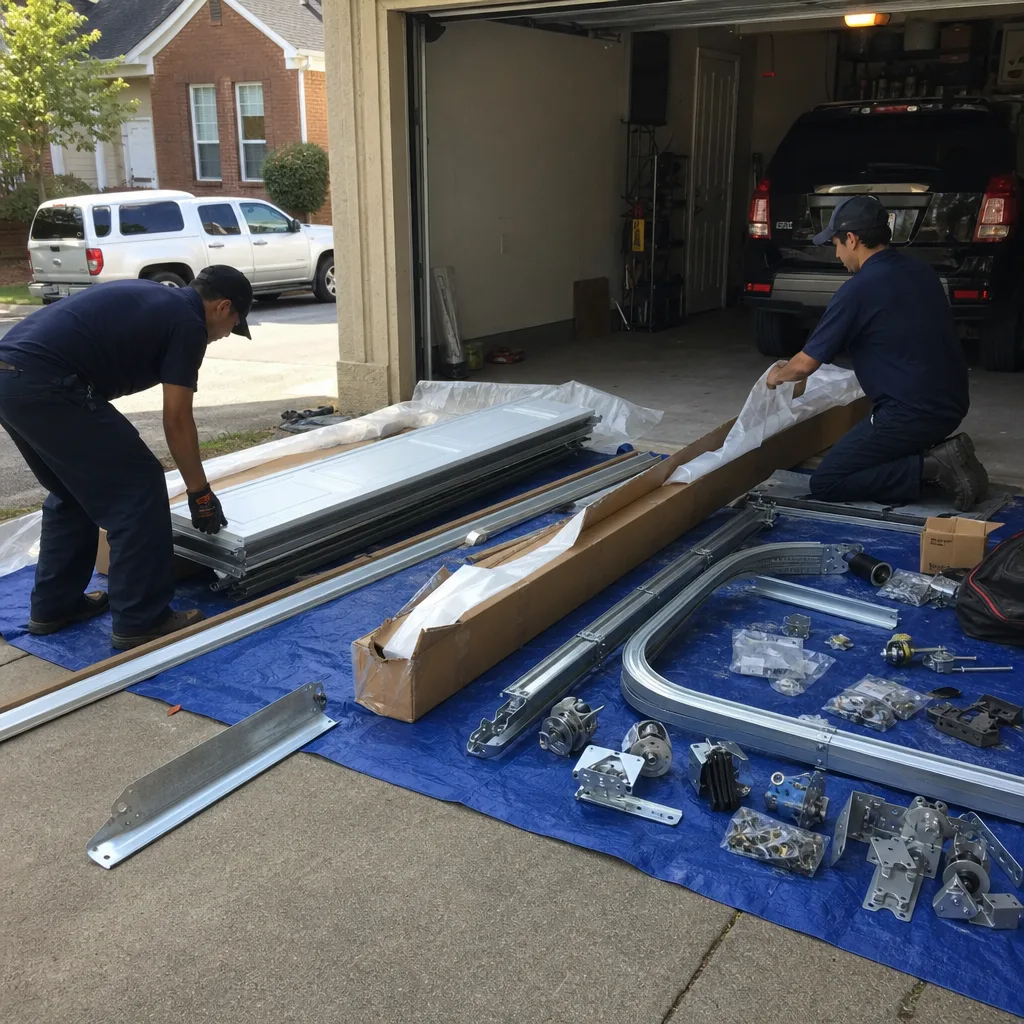
Call a professional if the warning sign falls in Tier One, if a Tier Two sign has been present for more than two weeks, or if you’re unsure which tier applies. The safest way to resolve uncertainty is a diagnostic visit. In Douglasville, we quote diagnostics at a flat, written price before we arrive, and we photograph what we find before we quote any repair. You’ll see the failed component with your own eyes, on your own phone, before you agree to any work. That’s Clause 4 of The Haven Standard, and it’s the reason we built the company this way in 2015. If another Douglasville company has given you a written estimate and you want a second opinion, bring the paperwork. The second opinion is free. Servo Garage Doors Douglasville home services the entire Douglasville area, and our technicians carry parts for all eight major brands we service, including LiftMaster, Chamberlain, and Genie openers, and Clopay, Amarr, and Wayne Dalton doors. Call (470) 243-8314 for a flat, written price before any work begins. If you’re considering a full replacement rather than a repair, we also handle Garage Door Installation in Douglasville with the same written-price-first process.
Frequently Asked Questions
Most mechanical repairs in Douglasville run from $140 to $340 depending on the component. For more guides & resources, visit our blog. Roller replacement is typically $140 to $190 for a full set, spring replacement is $180 to $340 depending on spring wire diameter and door weight, and a logic board replacement is $180 to $260. These are flat, written prices quoted before work starts, not estimates that change after the fact. Call (470) 243-8314 for a specific quote on your door, and you’ll get the number in writing.
Yes. Broken spring calls in Douglasville are handled same-day, and our live phone is answered around the clock, including holidays. We tell you the technician’s name and send an on-the-way text with a real ETA, not a callback window. The price is quoted before the technician arrives, and you approve it in writing before work starts.
No. The flat written price covers the scope of work we quote, and Clause 1 of The Haven Standard means the written scope and written price are delivered before any work begins. If the technician finds something additional that requires a separate repair, it gets a separate written price and your approval before that work starts. You never get a bill bigger than the quote you approved.
Yes. Our Douglasville service vehicles carry torsion springs in multiple wire diameters, cable sets, rollers, hinges, and common opener components for LiftMaster, Chamberlain, Genie, Clopay, Amarr, Wayne Dalton, Craftsman, and Raynor. Most repairs are completed on the first visit.
Use the thirty-second disconnect test: pull the emergency release, lift the door to the halfway point, and let go. If it stays put, the door balance is fine and the opener is the likely culprit. If it drops more than six inches, the spring is the problem and the opener is fighting extra weight. This test is the same one we use on every diagnostic call, and it separates opener issues from door issues without tools.
Standard torsion springs are rated for 10,000 cycles, which translates to roughly 5 to 7 years for a Douglasville door that cycles two to three times a day. Builders in fast-growing Douglasville subdivisions often installed 5,000-cycle springs, which fail in 3 to 5 years. If your door is original to a home built between 2015 and 2020 and it hasn’t had a spring replacement yet, it’s likely due. We can tell you the spring’s cycle rating at the diagnostic visit.
The Bottom Line
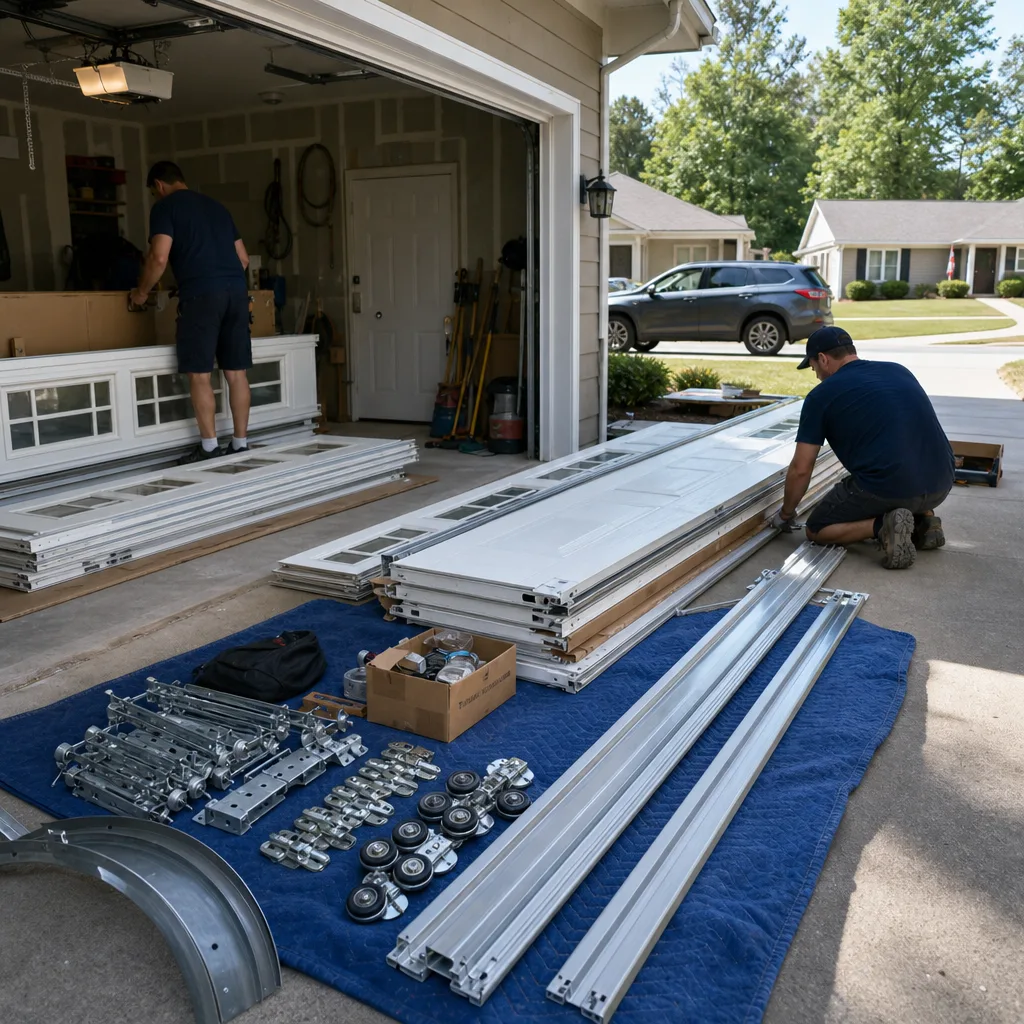
Garage door warning signs are not all equal, and knowing the difference between a cosmetic quirk and a failing counterbalance system is the difference between a $190 repair and a door falling off its tracks. Tier One signs mean stop using the door today. Tier Two signs mean schedule within two weeks before the damage compounds. Tier Three signs mean write it down, check it monthly, and reclassify if it worsens. The tests in this guide, the thirty-second balance check and the winding cone visual check, are things any Douglasville homeowner can do safely without tools. When the sign points to a real repair, get a flat written price before any work starts, and get a photo record of what was found and what was done. That’s how you know you hired a company that leads with evidence, not urgency.
Written by Marcus Deller, Owner at Servo Garage Doors Douglasville, serving Douglasville since 2015.